
 English
“Artemis-2” documents what humans have never seen before on the moon… a shocking moment that redefines space exploration!

Arab Weather - In a new historical development in the space exploration race, the crew of the “Artemis-2” mission continued their journey towards the moon, recording one of the most exciting moments in the history of manned spaceflight.
NASA announced that the Orion spacecraft has reached two-thirds of the distance to the moon, settling at a distance of approximately 322,000 kilometers from Earth, while approaching its lunar target at a distance of only 132,000 kilometers.
An unprecedented historical moment on the surface of the moon
In a scientific first, astronauts were able to directly observe the “Eastern Sea” basin (Mare Orientale) from inside the spacecraft, which is one of the rarest and most complex lunar formations.
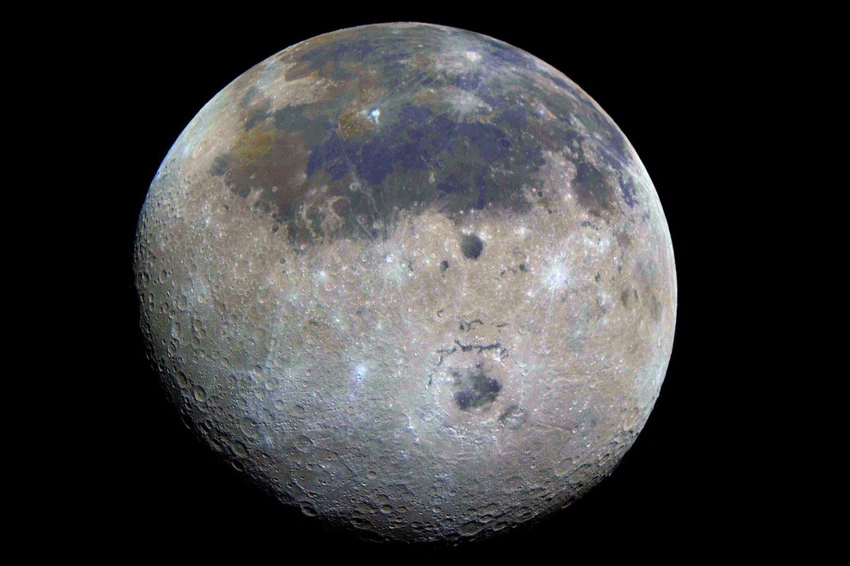
NASA confirmed that this is the first time in history that humans have seen this huge lunar basin directly with the naked eye, after it had been known for decades only through satellite images and unmanned probes.
What a breathtaking view inside Orion
From inside the Orion spacecraft capsule, astronaut Christina Koch described the scene as an “unforgettable” moment, saying: “We’ve never seen anything like this before… The basin looks like a huge wound or a target drawn on the surface of the moon. The detail is so amazing it’s almost unbelievable.” She added that seeing this formation firsthand for the first time “makes the moon look alive in a way that’s completely different from what we see in pictures.”
Towards the farthest point from Earth in history
Over the next few hours, the mission is preparing to enter the lunar gravitational influence zone, the point at which the moon's gravity becomes stronger than Earth's gravity on the spacecraft.
As the journey continues, the crew of three Americans and a Canadian are on track to break a new record, becoming the furthest humans from planet Earth in history.
A vision that surpasses "Apollo"
The Artemis-2 mission features a unique orbit that gives the crew an unprecedented panoramic view of the lunar surface, far exceeding what the historic Apollo missions achieved.
While the Apollo missions flew at low altitudes, Orion reached great distances, allowing a complete view of the far side of the moon and the polar regions for the first time with such clarity.
Live documentation from space
For the first time, NASA allowed the crew to use personal cameras to document the journey, and has already released stunning images of Earth from deep space, showing the blue planet amidst a sea of cosmic darkness.
A step that paves the way for the Martian era
The Artemis-2 mission is the cornerstone of NASA’s plan to return humans to the moon, paving the way for a permanent human presence there, and then launching on to Mars and beyond.


Arabia Weather App
Download the app to receive weather notifications and more..