
 English
The clash between cold and warm air masses foreshadows frequent weather and temperature fluctuations in the coming period.

Arab Weather - The transitional period between winter and spring is characterized by numerous weather and temperature fluctuations that are clear and noticeable in two close time periods. We can delve into the details of the situation further to explain the reason for the numerous weather fluctuations during this period.
The conflict between air masses with different characteristics continues. What are the scientific reasons behind this?
First: Red Sea Depression
With the arrival of spring, weather and temperature fluctuations increase due to the interaction of air masses originating from different sources. During this season, the Red Sea Trough (Mahou) becomes active. This thermal low-pressure system relies on temperature differences between the surface water temperature of the Red Sea basin and the land temperatures of the Arabian Peninsula and Sudan for its formation, intensification, and eventual merging or contraction. The Red Sea Trough is a sub-region of its parent system, the Sudan Thermal Low, and it causes a rise in temperatures and a drier atmosphere in many areas.
Second: Khamsin weather depressions
During this same period, the season for the Khamsin depressions begins. These are a type of thermal low-pressure system that becomes active in the spring. Khamsin depressions typically form in the Algerian Sahara, east of the Atlas Mountains, but their location varies; at times, they can also form in Libyan territory.
This type of low-pressure system is formed as a result of the high heating of the land (the Earth's surface). In the spring, temperatures in the north of the African continent begin to rise as the Earth's surface heats up. Due to the difference in specific heat between the land and the water, the surface of the Mediterranean Sea remains cold, and the land becomes warmer. Thus, the air on the land begins to expand, its weight decreases, and the atmospheric pressure drops, announcing the formation of a Khamsin low-pressure system in the Sahara Desert of Africa.
At the forefront of the Khamsin depressions, dry, warm (or hot), and dusty weather prevails. However, the Khamsin depression quickly moves away, followed by a cooler air mass that causes a sharp drop in temperatures, sometimes within as little as 24 hours. Khamsin depressions are among the most prominent causes of temperature fluctuations in Jordan's spring climate.
Third: The cooler air masses remain able to reach the region
At the same time, cooler air masses continue to flow towards the eastern regions of the European continent, losing much of their coolness upon reaching the Mediterranean Sea. This affects the countries of the eastern basin, often in the form of spring-like air masses. However, this depends on the specific cooling of the air mass approaching the Mediterranean; it cannot be guaranteed that it will always be spring-like.
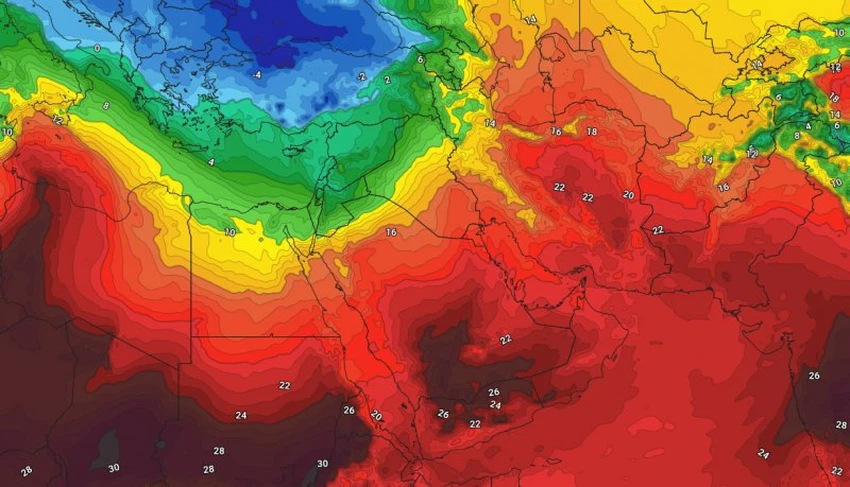
Here begins the conflict between air masses coming from the eastern part of the European continent and others coming from the Arabian Peninsula or the Red Sea and North Africa, and thus temperature fluctuations become remarkably frequent and the chances of contracting seasonal diseases such as colds and seasonal influenza increase.
And God knows best.


Arabia Weather App
Download the app to receive weather notifications and more..